
Binary numbers for kids, explained
Binary is a way of writing numbers with only two digits, 0 and 1. Computers use it because each tiny switch inside them can only be off (0) or on (1). Each place in a binary number is worth double the place to its right: 1, 2, 4, 8, 16, 32, 64 and 128. To read a binary number, add up the places that have a 1.
Try it: tap a switch
00000000
= 0
Switches that are on add up. All eight on makes 255, the biggest number eight switches can hold.
How to count in binary
Start with four places worth 8, 4, 2 and 1. Zero is 0000. To count up, switch on the 1. To go past 1, switch the 1 off and the 2 on: that is 0010, which means two. It works like a car's mileage counter, except each place rolls over after 1 instead of after 9.
Four places count from 0 to 15. Every extra place doubles how far you can count, so eight places reach 255.
| Number | 8 | 4 | 2 | 1 |
|---|---|---|---|---|
| 0 | 0 | 0 | 0 | 0 |
| 1 | 0 | 0 | 0 | 1 |
| 2 | 0 | 0 | 1 | 0 |
| 3 | 0 | 0 | 1 | 1 |
| 4 | 0 | 1 | 0 | 0 |
| 5 | 0 | 1 | 0 | 1 |
| 6 | 0 | 1 | 1 | 0 |
| 7 | 0 | 1 | 1 | 1 |
| 8 | 1 | 0 | 0 | 0 |
| 9 | 1 | 0 | 0 | 1 |
| 10 | 1 | 0 | 1 | 0 |
| 11 | 1 | 0 | 1 | 1 |
| 12 | 1 | 1 | 0 | 0 |
| 13 | 1 | 1 | 0 | 1 |
| 14 | 1 | 1 | 1 | 0 |
| 15 | 1 | 1 | 1 | 1 |
How to turn a number into binary
Use the biggest place that still fits, take it away, and repeat until nothing is left. Every place you used is a 1; every place you skipped is a 0.
13 in binary
- 13: the biggest place that fits is 8. 13 − 8 = 5
- 5: 4 fits. 5 − 4 = 1
- 1: 2 does not fit, so 2 is 0. 1 fits. 1 − 1 = 0
13 = 8 + 4 + 1 = 1101
200 in binary
- 200: 128 fits. 200 − 128 = 72
- 72: 64 fits. 72 − 64 = 8
- 8: 32 and 16 do not fit. 8 fits. 8 − 8 = 0
200 = 128 + 64 + 8 = 11001000
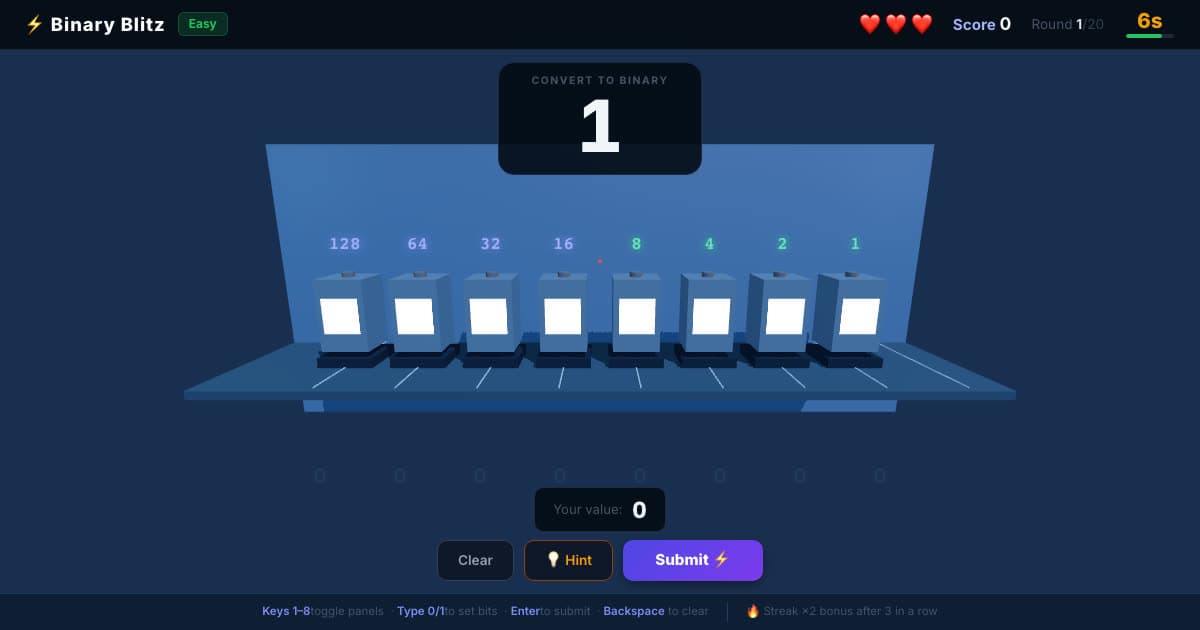
This is exactly the trick that wins at Binary Blitz: start with the biggest switch, 128, and work down.
Why computers use binary
A computer chip holds billions of tiny electronic switches. Each one is either off or on, which is easy to build and hard to get wrong, so computers store everything as 0s and 1s. One switch is a bit; eight bits together are a byte.
Letters, pictures and sounds become numbers first. A colour on screen, for example, is often three numbers from 0 to 255, one byte each, for red, green and blue. Children meet exactly this in our Year 3 course, mixing colours with numbers in real code.
Where binary sits in the curriculum
- “Understand how numbers can be represented in binary, and be able to carry out simple operations on binary numbers [for example, binary addition, and conversion between binary and decimal]”
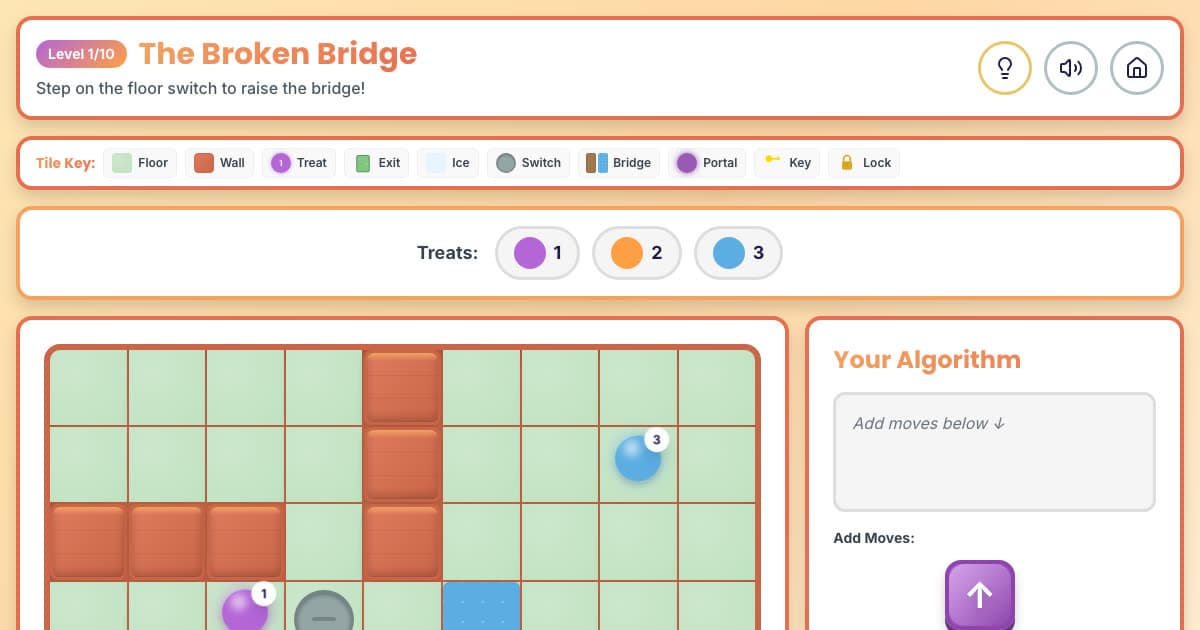
That is a secondary-school statement, so binary is a head start for Years 5 and 6. On U Teach Mi it comes in Year 4, in the lessons Binary Beast Codes (Store and Use Data) and Power the Binary Reactor (See Under the Hood).
Binary at home, no screen needed
Count on one hand to 31
Make your thumb worth 1, then 2, 4, 8 and 16 across the fingers. A raised finger is a 1. Can your child show 7? 19?
Write your age in binary
A 9-year-old is 1001 (8 + 1). Do the whole family, then work out the binary for the next birthday.
Five cards
Draw 16, 8, 4, 2 and 1 dots on five cards. Turn cards face up or down to make a number: face up is 1, face down is 0.
From binary to real code
Binary is one small part of how computers work. The membership covers the rest, step by step: algorithms, programs, networks and data, in courses for every primary year.
- 36 coding courses, six for each year from Year 1 to Year 6
- A live online lesson with a teacher, Wednesdays 5–6pm UK time
- Daily Maths & English practice
- A parent dashboard showing what your child has done
£15 a month, up to two children
7 days free, then £15 a month for up to two children (£7.50 a month for each extra child). Card needed; cancel any time.
Questions about binary
What is 10 in binary?
1010. Ten is 8 + 2, so the 8 and the 2 places are 1 and the 4 and the 1 places are 0. Reading from the left: 1 (eight), 0 (four), 1 (two), 0 (one).
Why is binary called base 2?
Because it uses two digits, 0 and 1, and each place is worth twice the place to its right. Our everyday numbers are base 10: ten digits, and each place is worth ten times the one to its right.
What is the biggest number you can make with 8 bits?
255, which is 11111111: 128 + 64 + 32 + 16 + 8 + 4 + 2 + 1. Counting 0 as well, eight bits can make 256 different numbers.
Do children learn binary at primary school?
Binary is named in the Key Stage 3 computing curriculum, which starts in Year 7, though some primary schools introduce it earlier. On U Teach Mi it first appears in Year 4.
What age is Binary Blitz for?
Ages 8 to 12. It starts with numbers up to 15 and builds to numbers up to 255 over twenty rounds, with a shrinking timer. Younger children can start with the switches on this page, which have no timer.